ActivityPub vs AT Protocol vs Nostr Compared for Publishers
Three open protocols carry most of the decentralized social web: ActivityPub behind Mastodon and the fediverse, the AT Protocol behind Bluesky, and Nostr. Each one answers the same questions differently. Who holds your account? Where do your posts live? What happens when you want to leave? Who decides what's allowed?
For a publisher, those answers decide how much setup you face, how much control you keep and how many readers you can reach. Here's how they compare, as of November 2026.
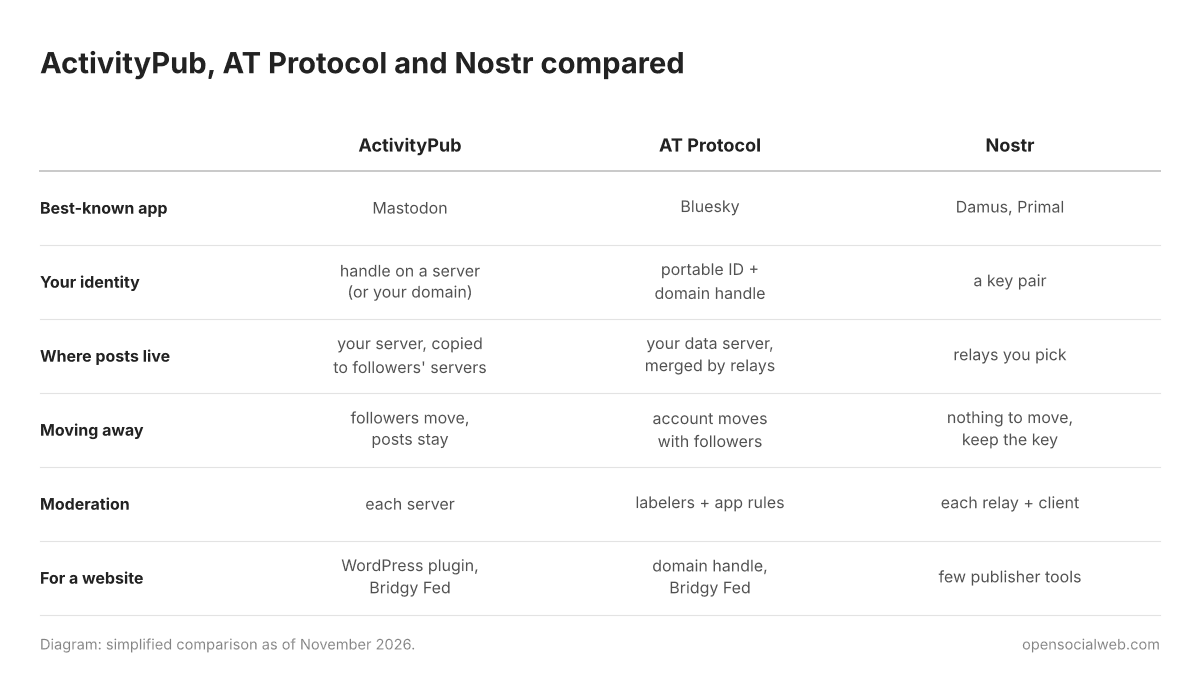
Diagram: Open Social Web, hosted at Pxef.com
Identity
ActivityPub ties you to a server. Your handle is @name@server. If the server is yours, say your WordPress site, the handle is on your domain and nobody can take it. If it's someone else's Mastodon server, you're a tenant.
AT Protocol gives you a permanent ID that isn't tied to any server, plus a readable handle that can be your own domain. You can change hosts and keep both.
Nostr makes you a key pair. No server ever owned the account, so there's nothing to move. The flip side: lose the key and there's no one to ask for help.
Where your posts live
ActivityPub sends copies of your posts to every server where you have followers. They live in many places at once, and each server keeps its own.
AT Protocol keeps the master copy in your data server. Relays gather everyone's updates into one stream, and apps build timelines from it.
Nostr stores your notes on the relays you choose to publish to. Readers fetch them from there.
Leaving
On ActivityPub, Mastodon can move your followers to a new account. Your old posts stay behind. On your own domain the question rarely comes up, because you're not leaving yourself.
On AT Protocol, an account can move to a new data server with its posts and followers. It works, though few people have done it.
On Nostr, you keep the key and publish to different relays. Nothing else needs to move.
Moderation
ActivityPub moderates per server. Each server has rules and can block other servers entirely. A reader's experience depends a lot on where they signed up.
AT Protocol splits moderation into layers. Bluesky's app applies its own rules, and anyone can run a labeler that tags content. Users choose which labelers to trust.
Nostr leaves it to relays and clients. Each relay decides what to accept, each app what to show. There's no central authority to complain to.
What a website can do with each
ActivityPub has the best publisher tooling by a wide margin. WordPress has an official plugin that turns the site into an account, Ghost has built-in support, and Bridgy Fed bridges static sites. See the WordPress guide.
AT Protocol lets you prove your site owns the account by using your domain as the handle, and Bridgy Fed can post your feed there. Native website integration is thinner. See Bluesky and the AT Protocol.
Nostr lets you link a key to your domain with a small file, and supports long-form articles. Website tools are few. See Nostr Explained.
Which to start with
Most publishers should start where the tooling is easiest and the domain stays theirs: ActivityPub on their own site, then bridge it to Bluesky. Add a Bluesky account with a domain handle if the audience is there. Treat Nostr as optional, worth a domain-verified name if your readers use it.
None of them replaces your site or your RSS feed. They're different roads to the same address. The pattern that ties them together is POSSE: publish on your own site, syndicate to each network.