EU Digital Markets Act and Social Network Interoperability, Why Facebook Won't Have to Federate Yet
Imagine following a Facebook page from Mastodon, or replying to an Instagram post from a Bluesky-style app. For a few years that looked like it might come by law rather than by goodwill. The EU's Digital Markets Act already forces the biggest messaging apps to open up, and the law asked the European Commission to consider doing the same for social networks.
In April 2026 the Commission decided not to, at least for now. For publishers betting on the open social web, that matters: the big platforms won't be made to connect to it any time soon.
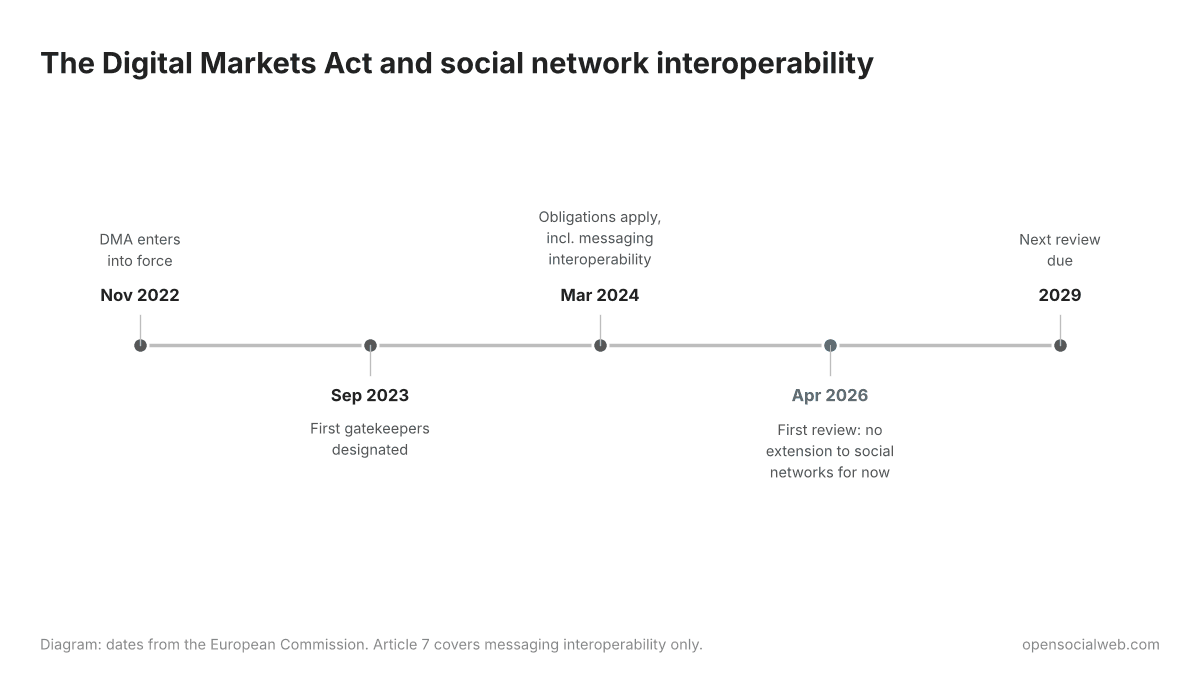
Diagram: Open Social Web, hosted at Pxef.com
What the DMA does
The Digital Markets Act targets "gatekeepers," the few companies whose platforms sit between businesses and users at huge scale. It entered into force in November 2022. The first gatekeepers, including Alphabet, Apple, Meta and Microsoft, were designated in September 2023, and most obligations have applied since March 2024.
Article 7 is the interoperability clause. It makes gatekeepers open their messaging services, such as WhatsApp and Messenger, so that rival apps can exchange messages with them. It covers messaging only.
The 2026 review
The law required a first review by May 3, 2026, and one specific question in it: should Article 7 be extended to online social networking services? That would have obliged a gatekeeper running Facebook or Instagram to let users connect with people on other interoperable social networks.
The Commission published its review on April 28, 2026. It found the DMA broadly working and decided it was too early to extend interoperability to social networks. It also kept the list of covered services as it was, and didn't add generative AI services.
The reasoning, as critics summarised it, was that there was no clear demand from users and businesses, and that social network interoperability is technically complex. Some academic work fed that view: a February 2026 CERRE paper argued that interoperability could only ever cover a subset of features, leaving the network effects of the big platforms largely untouched, and that people using several apps at once was a workable alternative.
Digital rights groups disagreed. The EFF argued that the Commission manages to require messaging interoperability despite technical and privacy hurdles, and that complexity shouldn't be a shield for social networks. It also pointed out that the law doesn't need to pick a protocol to demand real interoperability outcomes.
What it means for publishers
No forced bridge to Facebook or Instagram. Your fediverse or Bluesky presence won't reach those audiences by law any time soon. The next scheduled review is three years out.
Data portability still helps. The DMA does let users download their data, including social media posts, and authorise other companies to access it. That's useful for moving archives, less so for moving audiences.
Voluntary federation is what there is. Among gatekeeper services, the clear link to the fediverse is Threads, and that's by Meta's choice, on Meta's terms, and patchy in Europe. See Threads and the Fediverse.
Build for the open side on its own merits. The case for a federated site and a good RSS feed never depended on Brussels. It rests on owning the relationship with your readers, which is the theme of Platform Risk: Four Times Publishers Were Cut Off.