Platform Risk: Four Times a Platform Change Cut Publishers Off Overnight
Every publisher who built on a platform made the same quiet bet: that the platform's interests and theirs would keep lining up. Sometimes they do. When they stop, the platform doesn't need to ask, warn or explain. It changes a setting, and a channel that brought half your readers brings almost none.
Four cases from the last decade show how this tends to go. None of them was a bug or an accident. Each was a business decision, announced in advance or not at all.
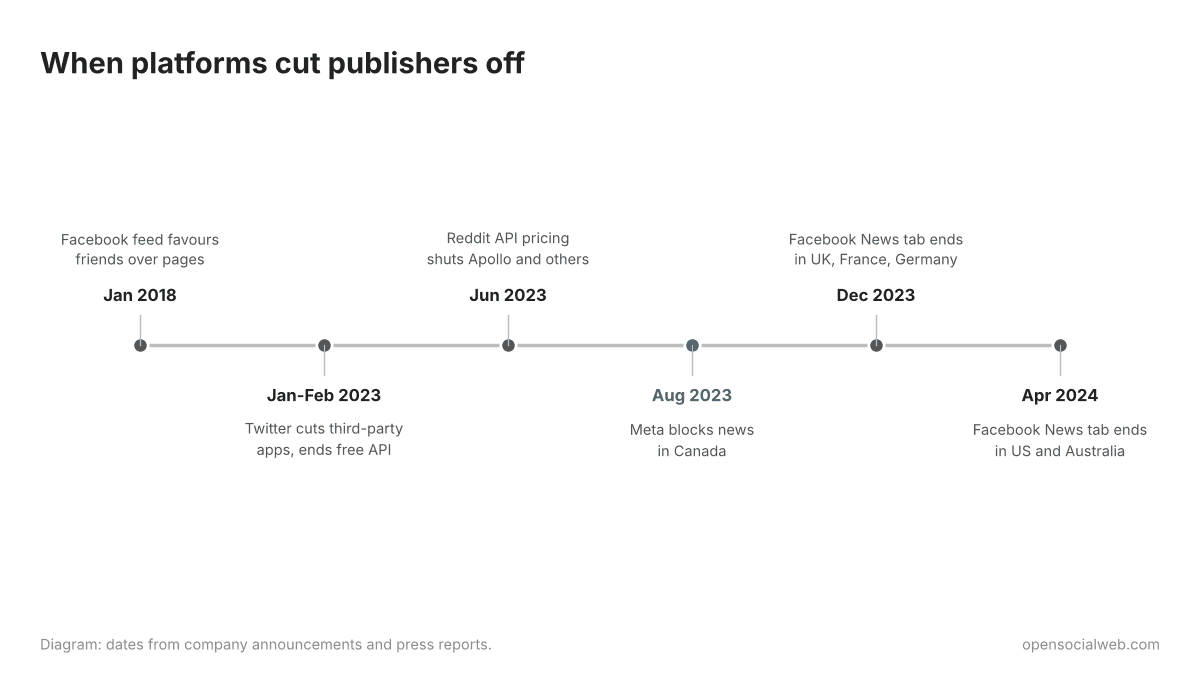
Diagram: Open Social Web, hosted at Pxef.com
1. Facebook turns away from news, 2018 onward
In January 2018 Facebook changed its News Feed to favour posts from friends and family over posts from pages, including publishers. Mark Zuckerberg framed it as "meaningful interactions." Publishers saw referral traffic fall, and many sites that had grown on Facebook shares never recovered it.
That was the first step in a long retreat. Facebook later wound down its dedicated News tab, ending it in the UK, France and Germany in late 2023 and in the US and Australia in 2024. Each step was small. Added up, the biggest referral source many sites had spent years courting stopped treating news as something it wanted.
The lesson: a platform's feed priorities are product decisions, and they change when the product changes. A reach graph built on one feed mostly tracks that company's strategy.
2. Twitter closes its API, 2023
In January 2023 Twitter cut off popular third-party apps such as Tweetbot without notice. In February it ended free access to its API and moved developers onto paid tiers. Overnight, a lot of small tools stopped working: auto-posting bots, news alert accounts, academic research projects, the scripts that pushed a site's new articles to its Twitter account.
For publishers, the visible damage was automation. Anyone who relied on a free tool to post new articles had to pay, switch tools or post by hand. The less visible damage was trust. If the API could close once, any integration built on it could close again.
The lesson: a free API is a gift, and gifts can be withdrawn. Anything critical to your publishing should run on something you control or something with an open standard behind it, like RSS.
3. Reddit prices out third-party apps, 2023
A few months later Reddit announced API pricing that the developer of Apollo, the most popular third-party Reddit app, said would cost his app about $20 million a year. Apollo, Reddit is Fun, Sync and others shut down at the end of June 2023. Thousands of subreddits went dark in protest. Reddit held its line.
Publishers felt this less directly, but the case matters because it shows the limits of community pressure. Users, moderators and developers pushed back hard and publicly. The platform changed almost nothing.
The lesson: if a platform's owners decide a change serves the business, protest rarely reverses it. Plan for the change. Don't count on the backlash.
4. Meta blocks news in Canada, 2023 to 2026
Canada's Online News Act required big platforms to pay news publishers for their content. Meta's answer, starting in August 2023, was to block news on Facebook and Instagram for users in Canada. Canadians couldn't see news outlets' posts or share links to articles, whether the outlet was Canadian or foreign. Research afterwards found that news sites lost significant traffic and that partisan pages filled part of the gap. The block was still in place into 2026, with reports in January of patchy access returning and talk of a deal.
The lesson: platform risk isn't only about product changes. Law and politics can switch a channel off for an entire country, and your site doesn't have to be in that country, or even be a news site, to get caught in the definition.
What the four have in common
The warning time was short or nil. The decision sat entirely with the platform. And the sites hit hardest were the ones with the most traffic concentrated in one place.
The open social web doesn't make that risk disappear. It spreads it. A reader who follows your site through RSS, or through your own domain on the fediverse via the WordPress ActivityPub plugin, isn't held by any one company's settings. A Bluesky account on your own domain can move between hosts. A newsletter list is yours to export.
The practical steps are covered in POSSE Explained and RSS for Publishers. The newest version of this risk, AI answers taking the click, is in AI Crawlers and robots.txt.