Cloudflare's AI Crawler Controls: Default Blocking, the September 15 Rule and Pay Per Use
robots.txt asks AI bots to stay away. Cloudflare can actually stop them. Because Cloudflare sits in front of a large share of the web's sites, its defaults have quietly become one of the biggest levers in the fight over AI crawling. If your site runs through Cloudflare, including a free plan or Cloudflare Pages, those defaults may already apply to you.
Here's what changed, in order, and what to check as of November 2026.
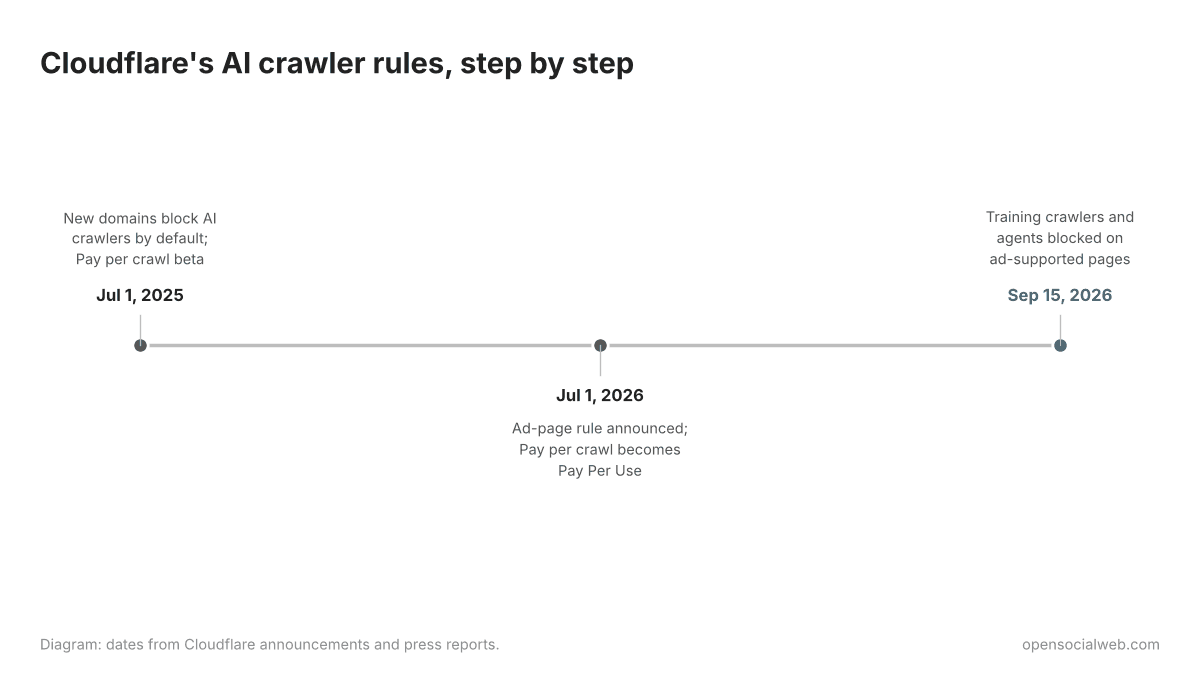
Diagram: Open Social Web, hosted at Pxef.com
July 2025: blocking by default
On July 1, 2025, Cloudflare switched new domains to block AI crawlers by default. Owners had to grant access to the bots they wanted, instead of chasing down the ones they didn't. A group of large publishers, including Condé Nast, TIME, The Associated Press, The Atlantic, ADWEEK and Fortune, backed the move.
The same day it opened a private beta called Pay per crawl. The idea: alongside allow and block, a third option, charge. A site sets a flat price per request, and an AI company either pays it or doesn't get in. For it to work, AI companies have to sign up too, and the beta stayed small.
September 15, 2026: ad-supported pages
On July 1, 2026, Cloudflare announced a tighter rule that took effect on September 15, 2026. It covers new customers, new sites added by existing customers, and free-plan users who haven't changed their settings.
Under it, pages that carry advertising are closed by default to AI training crawlers and AI agents. Search crawling stays allowed. The logic, in Cloudflare's framing, is that content that earns ad revenue shouldn't be harvested without the owner's permission.
The rule also targets mixed-use crawlers, bots that do search, training and agent work under one name. If a crawler doesn't let site owners separate those uses, it gets blocked on ad-supported pages. Cloudflare's stated aim is to push the big operators into splitting their bots.
Google is the obvious case. Googlebot feeds both Search and AI Overviews. Google, Apple and Microsoft each offer separate AI opt-out signals (Google-Extended, Applebot-Extended and Bing's noarchive tag), which may count as the separation Cloudflare wants. How each one is treated is worth checking in your own dashboard instead of assuming. Losing Googlebot by accident would cost most sites far more than any AI crawler.
Pay per crawl becomes Pay Per Use
The same announcement renamed Pay per crawl to Pay Per Use. The change is in what triggers a payment. It's meant to follow use, for example when a page shapes an AI answer, where the old model charged for each fetch. The first named partners were Ceramic.ai, an API search business that pays when a publisher's content appears in its results, and You.com, a search engine for AI agents, which pays when agents request content.
Cloudflare also added a dashboard showing which bots use a site's content and how much traffic their products send back. For many sites, that second number is the eye-opener.
What to do if your site is on Cloudflare
- Open the bot and AI crawler settings for each zone and see what's blocked. Sites set up before the changes may be on older defaults. Newer ones are likely blocking more than you think.
- Make a decision per bot type. The usual publisher choice, set out in AI Crawlers and robots.txt, is no to training, yes to search and AI search.
- Check search crawling explicitly. After any change, confirm in your search engine's webmaster tools that pages are still being crawled.
- Keep robots.txt in step. Cloudflare enforces; robots.txt documents your intent for bots that honour it. Make the two agree.
- Look at the traffic numbers. If an AI product crawls thousands of pages and sends a handful of visitors, that's your answer for that bot.
Who this helps
Big publishers can negotiate licensing deals directly. Small sites can't. Default blocking gives a small site the same starting position as a large one: closed unless it says otherwise. Pay Per Use may or may not turn into real money for small sites, and it's too early to judge. The control, at least, is real, and it costs nothing to use.
It's also one more example of a platform setting the rules for everyone downstream. This time the rules favour publishers. Cloudflare can change them again, which is the theme of Platform Risk: Four Times Publishers Were Cut Off.