AI Crawlers and robots.txt: Which Bots to Block, Which to Keep and What Each Choice Costs
Your robots.txt file used to be about search engines. Now it's mostly about AI companies. A dozen or more AI bots visit a typical site, and they don't all do the same job. Some collect pages to train models. Some index pages for AI search, which can send you visitors. Some fetch a single page because a user asked a chatbot about it.
Blocking all of them is easy. Blocking the right ones takes a few minutes of thought. This guide sorts the main bots by job, as their operators describe them as of November 2026, and gives a starting robots.txt.
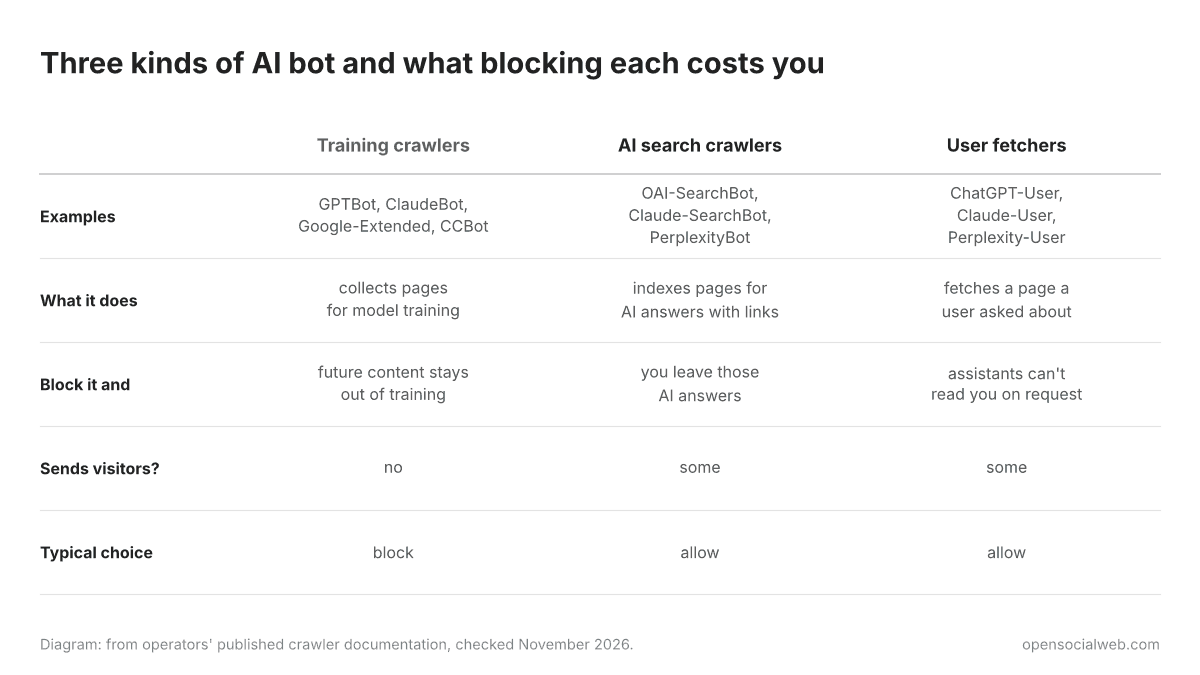
Diagram: Open Social Web, hosted at Pxef.com
Three kinds of AI bot
Training crawlers collect pages that may be used to train models. They send you nothing back. Blocking them is a statement that you don't want your future content in training data. It doesn't remove anything already collected.
AI search crawlers index pages so an AI product can cite and link to them in answers. Blocking them can take you out of those answers, and with them any clicks they'd send.
User-triggered fetchers visit a page because a person asked an assistant about it right then. Operators treat these more like a browser than a crawler, and some say robots.txt may not apply to them.
The main bots, by operator
OpenAI
GPTBot: training. OpenAI says disallowing it signals your content shouldn't be used to train its foundation models.OAI-SearchBot: ChatGPT search. Sites that block it won't appear in ChatGPT search answers.ChatGPT-User: fetches pages when a user asks. OpenAI says that because these visits are user-initiated, robots.txt rules may not apply.
Anthropic
ClaudeBot: training. Blocking it excludes your future content from training data.Claude-SearchBot: indexing for Claude's search features.Claude-User: fetches pages when a user asks Claude. Anthropic says it respects robots.txt for all three, and supportsCrawl-delayif you'd rather slow a bot down than shut it out.
Google-Extended: a robots.txt token, not a separate crawler. It controls whether content Google already crawls can be used for Gemini model training. Google says it doesn't affect Search inclusion or ranking.Googlebot: ordinary Search, which also feeds AI Overviews. Blocking Googlebot takes you out of Google Search. Don't block it when you mean Google-Extended.
Others worth knowing
Applebot-Extended: Apple's opt-out token for training, separate fromApplebot, which powers Siri and Spotlight search.PerplexityBot: indexing for Perplexity's answers.Perplexity-Userfetches on request.CCBot: Common Crawl, an open web archive that many AI training sets are built from.Bytespider: ByteDance.meta-externalagent: Meta's crawler for AI training.
A sensible default
For most independent publishers, the balance is: opt out of training, stay in AI search and user fetches where they can send readers.
# Training crawlers: opt out
User-agent: GPTBot
Disallow: /

User-agent: ClaudeBot
Disallow: /

User-agent: Google-Extended
Disallow: /

User-agent: Applebot-Extended
Disallow: /

User-agent: CCBot
Disallow: /

User-agent: Bytespider
Disallow: /

User-agent: meta-externalagent
Disallow: /

# Everyone else, including search and AI search
User-agent: *
Allow: /

Sitemap: https://example.com/sitemap.xml
If you want out of AI answers entirely, add OAI-SearchBot, Claude-SearchBot and PerplexityBot to the blocked list. Expect to lose whatever traffic those products send.
What robots.txt can't do
It's a request. Big operators publish their user agents and say they follow it. Smaller and unknown bots may not, and a bot can claim to be anything. If you need enforcement, it has to happen at the server or CDN, by checking user agents against the operators' published IP ranges. Cloudflare now does much of this by default, which we cover in Cloudflare's AI Crawler Controls.
It also only works going forward. Blocking a training crawler today doesn't pull your archive out of models already trained.
Check what's actually visiting
Before deciding, look at your logs. Search them for the user agents above and see who visits, how often and what they fetch. Crawl rates differ a lot between operators, and on a small site a heavy crawler can cost real bandwidth.
Then revisit the file every few months. New bots appear, names change, and operators split one bot into several, as Anthropic and OpenAI both have. We'll keep this list current and date each check.
For the wider picture of why publishers care, see What the Open Social Web Is.